- Aug 06, 2025
- Case Studies
13 Double Girder Bridge Cranes for Rolling Mills in Pakistan
Check out these 13 double girder bridge cranes designed for rolling mills in Pakistan! Discover how they enhance efficiency and safety in heavy lifting.
A major steel rolling mill in Pakistan wanted to modernize its material handling systems in five workshops. Yuantai supplied a total of 13 double girder overhead travelling cranes to meet diverse lifting tasks throughout the mill. At various stages of production, these cranes help to move heavy steel slabs, billets, rolls, and coils more efficiently. This case study details the customer's operational needs, challenges before crane adoption, technical design of the supplied double girder bridge cranes, performance in handling complex tasks, benefits realized, and other industry uses.
13 Bridge Cranes Product – Customer's Crane Need


In a modern steel rolling mill, crane systems are critical for ensuring seamless material handling across various production stages. From the initial reheating of slabs to the final dispatch of coiled steel, each phase involves the movement of heavy and often high-temperature materials that require precision handling, speed, and operational safety. To achieve these operational objectives, the customer requested a customized bridge crane solution adapted to the individual workflow of each workplace.
1. Reheating Furnace Area
In the reheating furnace area, the cranes are responsible for lifting and positioning massive steel slabs, often weighing between 20 and 40 tons. These slabs must be correctly put onto roller tables for admission into the rolling process. Due to the high temperatures and harsh working environment, the cranes in this section are designed with heat-resistant components, specialized hooks, and reinforced hoisting systems. Precise positioning is important to line the slabs with downstream processes, hence the cranes are fitted with modern control systems for precision load handling.
2. Roughing Mill
The roughing mill section involves moving billets weighing from 15 to 30 tons between various stands. Cranes here must operate rapidly and reliably to keep pace with the mill's throughput. These cranes are typically outfitted with high-speed hoisting mechanisms and robust gearboxes to manage the dynamic loading conditions. Anti-sway systems and automatic positioning functions are also integrated to enhance operational accuracy and minimize manual intervention, contributing to a safer and more efficient workflow.
3. Finishing Mill
In the finishing mill, bridge cranes handle steel bars weighing between 10 and 25 tons. These bars require careful handling as they undergo final sizing and shaping operations. Cranes used in this area are designed for precision control, often incorporating variable frequency drives (VFDs) for smooth acceleration and deceleration of load movements. Additionally, smart sensors and overload protection features ensure both product quality and operator safety during lifting and transport.
4. Leveling and Straightening
For the leveling and straightening process, the cranes lift 5 to 15 ton steel coils onto leveling machines. These coils must be handled delicately to avoid deformation. As such, the cranes in this section feature specially designed coil lifting devices such as C-hooks or coil tongs, which provide secure gripping without damaging the product. Low-speed, high-control hoisting ensures accurate placement, while the control systems offer both manual and semi-automatic modes for operational flexibility.
5. Coiling and Dispatch
In the final stage of production, cranes are used to load finished coils ranging from 5 to 20 tons onto transport trolleys or storage racks. Fast cycle times and reliability are critical in this area to prevent bottlenecks and ensure timely shipment. Cranes in the dispatch area are optimized for efficiency, with high-duty cycles, redundant safety features, and integrated logistics interfaces for communication with warehouse management systems. These features support streamlined dispatch operations and minimal downtime.
6. Crane Specifications and Operational Requirements
To address the diverse handling needs across the entire production line, the customer required bridge cranes with lifting capacities ranging from 10 tons to 50 tons, span lengths from 12 meters to 30 meters, and hook heights between 6 meters and 12 meters. All cranes needed to be provided with uniform control systems for operator familiarity, upgraded safety features including emergency stop systems and load limiters, and high reliability to support 24/7 operation with minimal downtime. The integration of smart diagnostics and maintenance alerts was also a vital requirement to ensure preventive maintenance and reduce unscheduled service outages.
13 Bridge Cranes Product Design Provided by Yuantai


To meet the demanding operational requirements of a large-scale steel processing facility, Yuantai designed and delivered a complete material handling solution comprised of 13 customized double girder bridge cranes. Each crane was intended to fit effortlessly into a variety of workshops, from the furnace area to the coil dispatch bay, with particular span, lifting height, and working conditions. The project prioritized lifting precision, structural stability, energy efficiency, and long-term dependability. The following is a breakdown of the major design features and custom adaptations that distinguish this solution.
1. Double Girder Bridge Structure
Each overhead crane employs a robust double girder box-section design, fabricated from Q345B high-strength structural steel. The girders were dimensioned using finite element analysis (FEA) to ensure optimal strength-to-weight ratio and structural performance. The design limits midspan deflection to less than L/800 under full rated load, ensuring precise and stable lifting even during high-capacity operations. This rigidity is especially critical when handling heavy steel slabs or coiled materials, where load sway or girder deformation could pose serious safety risks or disrupt production processes.
2. Variable Span and Hook Height Configurations
To accommodate diverse workshop layouts and functional requirements, Yuantai delivered cranes with customized spans and hook heights:
- Span Ranges: Spanning from 12 meters in compact finishing zones to 30 meters across the wide-span coiling sheds.
- Hook Heights: Designed for process-specific clearances—6 meters for routine coil handling, and up to 12 meters in the furnace workshop for safe maneuvering above thermal equipment and access structures.
These dimensional configurations ensured efficient load handling with minimal interference from building architecture or process equipment.
3. High-Capacity Hoists and Dual-Speed Motors
The cranes are equipped with QDY series wire rope hoists, built to handle a wide range of load sizes with precision and durability:
- Lifting Capacities: Options included 10-ton, 20-ton, 30-ton, 40-ton, and 50-ton hoists.
- Hoist Speeds: Dual-speed motor configuration provides a fast mode (10–20 m/min) for lifting without load, and a precision mode (1–2 m/min) for controlled placement.
- Wire Ropes: High-strength ropes (Ø28–Ø36 mm) with a tensile rating of 1960 N/mm², reeved onto multi-groove drums to minimize wear and ensure consistent winding over time.
These hoists deliver powerful and reliable lifting performance with minimal maintenance requirements.

4. Bridge and Trolley Travel Drives
All cranes feature variable frequency drive (VFD) technology from top-tier manufacturers such as ABB or Siemens, combined with IE3-grade energy-efficient motors:
- Smooth Travel: VFDs enable soft start/stop motion for both the bridge and trolley, significantly reducing shock loads and minimizing structural stress.
- Speed Range: Adjustable travel speeds from 20–40 m/min, which can be fine-tuned to match each workshop's production tempo or load type.
This ensures not only precise handling but also energy savings and reduced wear on mechanical components.
5. Control and Safety Systems
Operator control and crane safety were key priorities in Yuantai's design:
- Control Options: Each crane is equipped with a 36 V low-voltage pendant control and an optional 2.4 GHz wireless remote, giving operators flexible and safe handling options.
- Overload Protection: Electronic load cells automatically cut power when loads exceed 110% of rated capacity.
- Limit Switches: Dual safety measures—mechanical and electronic—prevent over-travel of the hook and trolley/bridge motion.
- Anti-Sway Control: Built-in algorithms reduce load swing during braking or directional changes, improving precision and minimizing risk to personnel.
- Emergency Stops: Strategically placed emergency stop buttons on the pendant, wireless remote, and main panel ensure immediate shutdown in case of danger.
These systems collectively ensure high operational safety and compliance with industrial lifting standards.
6. Structural Integration and Rails
The cranes were integrated with the facility's existing infrastructure using U71-profile steel runway rails, precision-aligned and securely installed:
- Rail Installation: Rails were welded directly to the building's runway beams, with laser alignment guaranteeing ±2 mm deviation over the entire span.
- End Buffers & Catchers: Heavy-duty buffers and mechanical catchers were installed to absorb kinetic energy and prevent overrun at travel limits.
This level of precision and protection ensures long-term stability and reduces the risk of rail misalignment or structural fatigue.
7. Workshop-Specific Adaptations
To ensure optimal performance in varied operational environments, several custom design adaptations were implemented:
- Furnace Workshop: Hoist drums and ropes were steam-cleaned post-welding to eliminate slag and protect against oxidation at ambient temperatures up to 120 °C.
- Leveling Shed: Low-headroom trolley configurations allowed cranes to operate below existing ductwork and overhead piping without compromising lifting capacity.
- Dispatch Bay: Cranes featured extended runways beyond the building structure to facilitate direct coil loading onto outbound trucks, streamlining the shipping process.
These modifications ensure seamless performance in specialized operating environments, enhancing productivity and safety.
Performance in Diverse and Challenging Tasks with 13 Bridge Cranes Product


The installation of 13 Yuantai bridge cranes in five specialized workshops considerably improved material handling efficiency, operational precision, and workplace safety. Each crane is specifically designed for its purpose, which ranges from large slab lifting to delicate coil placing. They work together to provide an integrated overhead transport system that supports all stages of steel manufacturing. These cranes optimize lifting speed, load control, and space usage to enable seamless coordination between upstream and downstream processes, resulting in significant improvements in production speed, quality, and equipment uptime.
1. Slab Handling in Reheating Furnace Area
Two 50-ton Yuantai overhead cranes are responsible for lifting and positioning steel slabs—each weighing up to 40 tons—onto the roller tables that feed the reheating furnaces. These cranes are equipped with dual-speed hoists and advanced anti-sway technology, enabling precise placement with a tolerance of ±20 mm. This high degree of accuracy not only reduces slab loading time dramatically from 35 minutes to just 10 minutes per unit, but also ensures that slabs are correctly aligned, minimizing jams and mechanical wear. The reduction in loading time directly contributes to an 8% decrease in fuel consumption, as the furnace operates at a more consistent thermal load with fewer delays.
2. Billet Transfers in Roughing Mill
In the roughing mill area, 20-ton bridge cranes handle billets ranging from 15 to 30 tons, transferring them swiftly between roughing stands. These cranes feature variable hoisting speeds: a high-speed mode for fast empty-hook return, and a low-speed, high-precision mode for handling loaded billets across a span of 20 meters. The transition between speeds is smooth and responsive, allowing operators to adapt instantly to changing load conditions. According to on-site feedback, billet transfer time has been cut by 60%, while the gentler handling has notably reduced edge dents and surface damage, preserving billet quality and reducing scrap rates.
3. Bar Handling in Finishing Mill
Yuantai's 10-ton cranes in the finishing mill are tasked with handling long steel bars—some reaching up to 12 meters in length. These cranes are designed with extra-stiff girders and precision-aligned wheels to reduce horizontal deflection and sway during lifting, especially for off-center or asymmetrical loads. This enhanced structural integrity enables accurate bar placement within ±15 mm on moving roller tables, ensuring consistent alignment with downstream processing equipment.
4. Coil Loading in Leveling and Straightening Section
In the coil processing section, 15-ton bridge cranes manage the delicate task of positioning coiled steel—each weighing 5 to 15 tons—onto leveling and straightening machines. These cranes are fitted with ultra-low-headroom trolleys, allowing them to operate effectively in areas with overhead obstructions such as ductwork and piping. Despite the constrained space, the cranes maintain high placement accuracy.
Yuantai Overhead Cranes


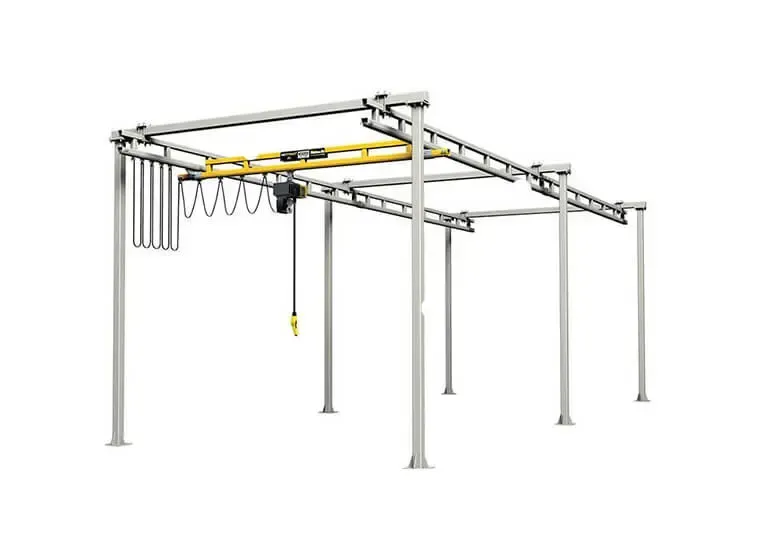
Other Applications for Bridge Cranes
While bridge cranes are commonly associated with traditional manufacturing operations, their versatility and lifting power make them important in a variety of industries. Bridge cranes provide reliable, efficient, and safe material handling solutions for everything from delicate assembly in automated manufacturing lines to transferring huge components in severe situations. The following are some of the primary applications of bridge cranes across various industries:
1. Manufacturing Facilities
Bridge cranes are essential in industrial processes because they transfer raw materials, semi-finished goods, and finished products between production stations. They optimize internal logistics by removing bottlenecks, increasing production, and lowering the risk of damage from physical lifting. Whether it is precision components or heavy dies, bridge cranes offer safe and efficient handling throughout the manufacturing process.v
2. Warehouses and Logistics Centers
These facilities operate under extreme heat and heavy-load conditions, requiring robust and heat-resistant crane systems. Bridge cranes equipped with specialized attachments, like ladles and lifting beams, are used to transport molten metal, steel slabs, ingots, and coils. Their high-load capacity and precision controls are crucial for maintaining safety and operational continuity.
3. Steel Mills and Foundries
These facilities operate under extreme heat and heavy-load conditions, requiring robust and heat-resistant crane systems. Bridge cranes equipped with specialized attachments, like ladles and lifting beams, are used to transport molten metal, steel slabs, ingots, and coils. Their high-load capacity and precision controls are crucial for maintaining safety and operational continuity.
4. Automotive Industry
Bridge cranes play an essential role in the automotive sector by supporting assembly line functions such as lifting engines, suspensions, transmissions, and vehicle bodies. Their ability to precisely maneuver large components enhances assembly efficiency and reduces the likelihood of product damage or misalignment. They’re also used in maintenance operations to handle heavy parts safely and quickly.
5. Paper and Pulp Plants
Handling large and fragile paper rolls requires equipment that combines strength with delicacy. Bridge cranes are used to move these heavy rolls and related machinery such as dryers and rollers. Their design allows for gentle and accurate handling in confined spaces, preventing product damage and ensuring operational efficiency.v
6. Shipbuilding Yards
The scale and complexity of shipbuilding demand lifting solutions capable of handling massive components such as hull sections, propulsion systems, and engines. Bridge cranes facilitate the accurate positioning of these parts, contributing to the precision and pace of ship construction and repair processes. Some shipyards even use dual cranes for synchronized lifts of oversized structures.
7. Mining Operations
In mining and mineral processing, bridge cranes are used to lift and move equipment such as crushers, pumps, and mill components. They also assist in handling heavy wear parts and maintenance tools in repair shops. Their durability and ability to operate in dusty, harsh environments make them an essential part of mining infrastructure.
Conclusion
Yuantai's delivery of 13 double girder overhead bridge cranes has transformed material handling in the Pakistani rolling mill. By addressing critical lifting tasks—slabs, billets, bars, coils, and maintenance loads—these cranes improved throughput, safety, and energy efficiency. The robust crane designs, from 10 ton to 50 ton capacities, provide precise control, low maintenance, and future scalability. Beyond rolling mills, the same crane solutions serve steel service centers, foundries, shipyards, power plants, and heavy manufacturing workshops. For any facility requiring high-capacity, precise, and reliable overhead lifting, Yuantai's double girder bridge cranes offer a proven solution.


