- Sep 05, 2025
- Case Studies
5 Ton HD Bridge Crane for Textile Mill in Sri Lanka
Discover the 5 Ton HD Bridge Crane designed for textile mills in Sri Lanka. Boost your efficiency and streamline operations with this reliable lifting solution!
A textile factory in Sri Lanka needed a reliable lifting solution. They handle heavy compressed cotton bales, chemical fiber bales, large fabric rolls and wound textiles. The customer wanted faster unloading. They wanted safer stacking and simpler warehouse management. After our detailed communication with the other party, we finally provided a 5-ton bridge crane for them.
What the Textile Mill Needed
For regular heavy lifting during production and storage, the textile mill needed a sturdy bridge crane. They need to lift no more than five tons. To safeguard fabric rolls and bales, it needed to offer precise, steady lifts. For multi-shift operations, the crane required high uptime and long-span coverage while maintaining aisle space for forklifts. Priorities included safety and less manual labor. One crane can manage loading from trucks, feeding production lines, and positioning goods on storage racks thanks to flexible attachments for rolls, bales, and boxes.


Lifting Solution We Offered — 5-Ton HD Bridge Crane with Box Girders and NR Hoist
We suggested a comprehensive overhead lifting system for this project that was based on a 5-ton HD bridge crane. The solution was created to increase workplace safety and workflow efficiency in addition to satisfying the client's lifting needs. Each part of the crane was chosen with care to ensure dependability, toughness, and user-friendliness. Because the system was tailored to the conditions of the mill, it was able to withstand constant, high-duty operation without experiencing any issues.
1. Heavy-duty box girder bridge
Heavy-duty box girders, which provide excellent stiffness and reduce deflection even across long spans, were used in the bridge's construction. This structural strength guarantees the crane's stability when handling large, unequal loads, which is crucial in demanding industrial activities. We fitted the system with an NR electric wire rope hoist to carry out the lifting duties. This hoist is well-suited for repeated usage in a production context because of its smooth operation, reliable performance in high duty cycles, and ease of maintenance.
2. NR type electric wire rope hoist
To enhance operational flexibility, we included industrial-grade trolleys and end carriages built for continuous movement. These components ensure reliable travel along the crane runway without excessive wear. The system was also prepared to handle different types of loads through custom lifting attachments, such as roll lifters, bale clamps, and spreader beams. These attachments make the crane versatile, allowing it to adapt quickly to different lifting tasks within the mill.
3. Safty control
For safe and user-friendly operation, we offered dual control options—a wired pendant control for precise ground operation and a wireless remote control for enhanced mobility. This flexibility allows operators to choose the most convenient control method for their work environment. We also built in multiple safety features, including overload protection, upper and lower limit switches, emergency stop functions, and travel limiters. Together, these safeguards help prevent accidents and protect both personnel and equipment.
4. Drive systems
The crane's drive system was fitted with variable frequency drives (VFDs) to deliver smooth acceleration and deceleration. This reduces mechanical stress on the crane components, extends equipment life, and provides more accurate load positioning. Since the crane will operate in a mill environment, we added special corrosion protection to shield the structure and critical parts from dust, moisture, and other corrosive elements.
We also provide professional installation and training, which ensures that staff can operate the equipment safely and efficiently. By tailoring the system to the mill's specific layout and workflow, we provided a lifting solution that not only met current needs but also offered long-term application.
Why We Chose a 5 Ton HD Bridge Crane — Technical and Practical Reasons
Choosing the right capacity, structural design, and hoisting mechanism is crucial for a textile mill that processes significant amounts of heavy and bulky materials. We selected a 5-ton heavy duty (HD) bridge crane with a box girder structure and an NR-type electric wire rope hoist after assessing the kinds of loads, the customer's workflow, and the requirement for dependable daily operation.

1. Why a 5 Ton Rated Capacity?
While compressed cotton or chemical fiber bales vary in size and density, most fabric rolls weigh between one and two tons per day. Even when several objects are being lifted simultaneously with the aid of spreader beams or specialist lifting attachments, a 5-ton crane offers sufficient leeway to manage these weights securely.
2. Why Box Girders for the Bridge?
Instead of using conventional I-beams for the bridge structure, we decided to use box girders. When large spans or exact load placement are needed, box girders' exceptional torsional strength is essential. When moving fragile fabric rolls that need to be kept steady to prevent damage, this structural stiffness reduces deflection and sway during crane movement. Operators can place loads more quickly and precisely when they don't swing too much, which lowers downtime and boosts workflow effectiveness. Additionally, under strong or recurring loads, box girders keep alignment better, reducing the requirement for corrective repair. In the long run, this results in reduced operational expenses and fewer production disruptions.
3. Why NR Type Electric Wire Rope Hoist?
Any overhead crane's hoisting mechanism is its core component, and in textile mills where cranes are operated constantly throughout the day, dependability is particularly important. Because it combines precision and longevity, we went with the NR-type electric wire rope hoist. Its long rope life guarantees less replacement costs, and its high duty cycle makes it appropriate for continuous operation. Operators can precisely manage load motions with smooth starting and stopping features, avoiding abrupt jerks that might harm delicate fabric rolls. Mechanical and electrical built-in safety features give workers and equipment an additional degree of protection. Direct access to vital parts like the brakes and drum makes maintenance simpler and minimizes downtime when repairs are needed.
4. Why Heavy Duty (HD) Design?
HD parts are designed to endure repeated use without rapidly deteriorating. Robust trolley assemblies and reinforced end carriages lower the possibility of unplanned mechanical failures that could stop output. The HD design increases service life and reduces overall maintenance needs by utilizing stronger, more resilient components. This dependability is not merely advantageous, but essential in sectors where every delay results in lost output.
Overhead Crane for Light-Medium Lift
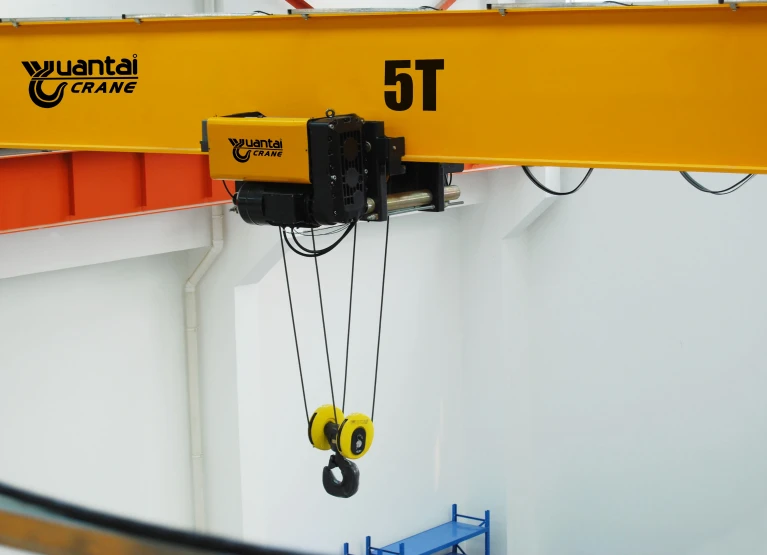

Detailed Crane Design — 5 Ton HD Bridge Crane Specifications and Features
Performance and durability are important considerations when designing a 5-ton HD bridge crane for a textile mill. The smooth handling of fabric rolls, bales, and other large goods is guaranteed by this crane's engineering, which was done with the working environment in mind. From the bridge girders to the finishing coat, every part was chosen with care to ensure a long service life, minimal maintenance requirements, and safe operation throughout regular production.
1. Bridge and Girders
The double box girder design used in the bridge's construction offers remarkable strength and rigidity. The girders' ability to support the rated load without deforming is guaranteed by the use of high-strength welded steel. The hoist and runway rails experience less stress because of the low deflection across the span, which aids in maintaining precision lifting. Secure couplings to the end carriages are made possible by reinforced bridge ends, which enhance alignment and increase the crane's lifespan. This sturdy construction guarantees durability even during continuous industrial use.
2. Hoist and Trolley
An electric wire rope hoist of the NR type powers the crane. With a 5 ton rated lifting capacity, this hoist is appropriate for handling both heavy and delicate textiles. In order to minimize wire rope wear and preserve steady lifting performance, the steel rope drum is designed with multiple layers of winding. Accurate load location is ensured while sliding is prevented via a precise drum and braking system. In order to minimize load shocks and safeguard the crane construction, the motor and gearbox are sized to produce smooth lifting actions. In a tough production environment, the hoist and trolley work together to deliver reliable performance.
3. End Carriages and Wheels
The end carriages' heavy-duty design improves stability and allows them to support the entire crane weight. Axle assemblies and hardened wheels can roll over the runway rails continuously without experiencing undue wear. By perfectly matching the wheel profiles to the rail design, friction is reduced and the rails' and wheels' service lives are increased. The use of grease fittings makes lubrication easier and aids the maintenance crew in maintaining the system's functionality. Downtime is minimal because of the robust structure and simple maintenance.
4. Drive Systems and Controls
With variable frequency drive (VFD) motors, movement is efficient and smooth. VFD technology enables exact speed adjustments, controlled acceleration, and gentle starts for the bridge travel motor. When necessary, a VFD-driven motor powers the trolley as well, avoiding jerky movements when carrying weights. For more versatility on the production floor, operators can choose between a wireless RF remote and a wired pendant control for direct operation. To ensure dependable and secure electrical operation, all controls are kept in an IEC-compliant cabinet with safety relays.
5. Lifting Attachments and Rigging
Specialized lifting equipment developed for textile applications is included with the crane. During lifting, rolls are held in place by a fabric roll lifter with a cradle to avoid damage or slippage. Compressed cotton bales can be safely grasped with a bale clamp, and handling several bales at once is made possible by a spreader beam. Operators may switch attachments with ease thanks to quick-change mounting points, which increases productivity and saves time. The crane can adjust to various manufacturing needs thanks to these tools, which give it adaptability.
6. Safety and Protection
Every aspect of the design incorporates safety. The crane can't lift more than its rated capacity thanks to a load moment and overload protection mechanism. Both extremities of the hoist's lifting range are safely stopped by upper and lower limit switches. Travel limiters prevent crashes and over-travel by regulating the trolley's and the bridge's movements. Both the pendant and the remote have emergency stop buttons that allow operators to instantly halt the device. To provide an additional degree of security, end-stops and anti-collision bumpers are installed where needed.


Advantages of Our 5 Ton HD Bridge Crane and NR Hoist Package
We provide durable and reliable cranes, after a month of use, our cranes are mainly and the following advantages:
1. Better Material Integrity and Less Waste
Handling sensitive or bulky materials can often lead to damage if equipment is not precise. The NR Hoist offers smooth lifting and controlled lowering, reducing the risk of fabric tears, surface scratches, or product deformities. By protecting the integrity of raw materials, the crane minimizes waste and boosts usable yield. This not only improves profits but also strengthens product quality and customer satisfaction.
2. Faster Material Handling
The crane speeds up normal material handling tasks by removing unnecessary stages. It makes it possible for staff to unload, stack, and reload items in a more direct manner. This reduces waiting times for both workers and machines, increasing manufacturing output. When load transfers proceed more smoothly and there are fewer delays, the production line as a whole becomes more dependable and efficient.
3. Fewer Labor Costs and Better Resource Use
Traditional lifting methods often require multiple workers to move heavy loads. With the 5 Ton HD Bridge Crane, fewer hands are needed for the same tasks. Workers are freed from repetitive, low-value lifting jobs and can instead focus on skilled tasks such as quality checks, packaging, or process improvements. As a result, labor costs per unit decrease, and the business gains more value from its existing workforce.
4. Safer Work Environment
Safety is a key concern in material handling, and this crane package directly reduces workplace risks. By eliminating the need for manual lifting and unsafe rigging, it protects workers from strains, slips, and accidents. Features like overload protection and ergonomic controls ensure safe operation even in demanding environments. A safer workplace means fewer injuries, lower insurance costs, and less downtime due to accidents.
4. Lower Lifecycle Costs
While the NR Hoist reduces mechanical stress while in use, the HD bridge structure is designed to last. When combined, they decrease unplanned breakdowns and increase service intervals. High-quality components and careful engineering extend the system's lifespan and reduce the need for frequent maintenance.
5. Energy Efficiency and Smooth Operation
With Variable Frequency Drives (VFDs) installed, the system improves performance and saves energy. By enabling smooth acceleration and deceleration, VFD technology lessens stress loads on the crane and the structure that supports it. This reduces mechanical wear in addition to electricity usage. A more ecologically friendly operation and lower service costs are the outcomes.


