- Dec 10, 2025
- News
Free-Standing Overhead Bridge Crane: Modular, Flexible
Free-Standing Overhead Bridge Crane is a modular, flexible lifting system that 2 uses its own floor-mounted support columns and track beams so it can be installed virtually anywhere in the facility.
Free-standing overhead bridge cranes are self-supporting crane systems that carry their own support columns, bolting directly to the floor and not requiring any building-mounted runway. In other words, these cranes stand on floor-mounted pillars and need no roof-beams or structural brackets. This makes them ideal for areas with high ceilings or where no overhead support exists. For example, Yuantai's KBK series is a single-girder free-standing bridge crane (with an aluminum main beam) that is widely used in factory, warehouse, etc.. By design, free-standing cranes eliminate costly building modifications and can be installed almost anywhere with a sturdy concrete floor.
Types & Configurations of Free-Standing Bridge Cranes
Free-standing overhead cranes come in different configurations depending on load requirements and span length. The two main girder configurations are single-girder and double-girder designs.


1. Single-Girder Free-Standing Bridge Crane
Single girder freestanding cranes use a truss beam to span multiple support columns. This lightweight design is typically used in low to medium duty applications. It has a lifting capacity of up to 3 tons and a span range of 1 to 10 meters.Such cranes are relatively lightweight, easy to assemble, and ideal for smaller work cells or assembly stations. Single-girder systems often serve as workstation cranes or light-duty bridge cranes. They are usually factory-built in modular kits (with columns, beams and trolleys) that can be bolted together on site. With only one beam, the hook is suspended below the girder, which limits maximum lift height by the girder depth. However, single-girder cranes are easier to install and cost less than double-girder systems. Common capacity examples include1-ton, 2-ton and 3-ton models for light industrial use. These are often referred to as light-duty free-standing cranes, suitable for moving small parts or assemblies in shops and warehouses.
2. Double-Girder Free-Standing Bridge Crane
When heavier loads or longer spans are needed, a double-girder free-standing crane may be used. This design has two parallel main beams, with the hoist typically rolling between them. Double-girder cranes can carry much higher capacities and achieve greater lifting heights, since the hook can travel above the full beam depth. In general, single-girder cranes are simpler and suited to light loads, while double-girder cranes handle heavy-duty applications.
Capacity, Span & Dimension Ranges
Free-standing cranes come in a wide range of capacities and sizes, matching the modular nature of the system. Capacity can be very light up to heavy industrial loads. Yuantai's KBK series covers roughly 0.25–5 tonnes, aimed at light-duty workstations. More typical single-girder industrial cranes go up to about 3t. Double-girder can handle material up to 5t. Span (distance between support columns) also varies by model. Yuantai's KBK series of freestanding bridge cranes have spans of 1-10 meters and are suitable for small and medium-sized work stations. Height is similarly flexible; a low-headroom design can maximize lift by minimizing the hook-to-ceiling clearance.
Components & Features of Freestanding Crane Systems
Freestanding bridge cranes are designed to be modular and highly flexible, making them ideal for facilities where permanent support structures are not feasible or where operational layouts may change. These cranes offer an independent support system that does not rely on the building’s framework. This allows you to install a crane system quickly and reconfigure it if your production or storage needs evolve. With their robust construction, precise control, and customizable options, freestanding cranes provide a safe and efficient solution for moving heavy loads in diverse industrial settings.
1. Bridge and End Trucks
The bridge serves as the main horizontal beam that spans your work area and supports the hoist system. Depending on your lifting requirements, it can be a single-girder or double-girder design. At each end of the bridge, you will find end trucks—wheeled assemblies that travel along rails mounted on vertical support columns. These end trucks are engineered to carry the full weight of the bridge and the load, while allowing smooth movement along the runway. Their precision design ensures stability, which is crucial for safe lifting, and they provide the foundation for reliable, long-term crane performance.
2. Trolley and Hoist
The trolley rides along the bridge and carries the hoist, which is the component that actually lifts and lowers the load. Depending on your application, the hoist can be an electric chain hoist for lighter loads or a wire rope hoist for heavy-duty lifting. Yuantai freestanding cranes allow you to choose the type that best suits your operations. The trolley may be motorized for automatic movement, giving you precise horizontal positioning over the load. This combination ensures you can handle materials safely and efficiently, reducing the time and effort required for manual load positioning.


3. Travel Drives
Movement of the crane is powered by travel drives. The bridge, for long travel along the runway, and the trolley, for cross travel along the bridge, are driven by electric motors often paired with gearboxes for durability. Advanced systems use variable frequency drives (VFDs) or inverters to regulate motor speed, which allows smooth acceleration and deceleration. This precision reduces mechanical stress and improves operator control. With these features, you can position loads accurately, even in confined or complex workspaces, while minimizing wear and maintenance costs.
4. Runway Electrification
Freestanding cranes require a reliable power supply for the hoist and drive motors. This is achieved through a runway electrification system, which may use a festoon cable system or an enclosed conductor rail (busbar). Yuantai typically equips its cranes with busbars mounted alongside the tracks, ensuring continuous power delivery and protecting cables from dust or debris. This not only improves safety but also enhances system longevity by minimizing wear and exposure. The electrification system is crucial for maintaining uninterrupted operation in busy industrial environments.
5. Control Systems
The crane can be controlled in multiple ways depending on your preference and operational needs. Operators can use a pendant control station from the ground or a wireless radio remote for greater flexibility. Yuantai’s cranes support both push-button pendant control and handheld radio control, allowing you to choose the method that maximizes safety and efficiency. Wireless operation keeps you out of potentially hazardous zones while providing full command over all crane movements.
6. Safety Features
Modern crane systems include many safety devices. Yuantai cranes can be fitted with overload protection, which prevents lifting beyond capacity, and limit switches that stop travel when the trolley or bridge reaches the end of the runway. Optional anti-collision sensors can stop the crane if two cranes or obstacles come too close. Other features include push-button stations at various locations, horn/warning lights, and emergency stop buttons. All these can be integrated on a freestanding system just as on a fixed crane.
7. Enclosed-Track and Ergonomic Options
For light-duty workstation cranes (like KBK series), the bridge often uses an enclosed track design. In an enclosed track crane, the conductor rail and trolley wheels are fully covered by steel flanges. This prevents dirt and debris from gathering on the track, ensuring smooth travel with minimal maintenance. Yuantai's workstation overhead cranes feature high-strength, lightweight enclosed tracks for easy maneuverability. If you use this crane, you can manually position the bridge or trolley effortlessly and this crane is very ergonomic.
In summary, a free-standing crane system includes the bridge girder(s), end trucks on columns, a motorized trolley/hoist, electrification (bus bars or festoon), drives and controls, and various safety systems. Yuantai's cranes use quality components (motors, drives, hoists, etc.) and offer options like VFD speed control, wireless radio, and anti-sway/anti-collision features to meet modern industrial requirements. All these parts come together to make a complete self-supported overhead crane cell.
Mobility, Installation & Site Considerations
One of the main advantages of a free-standing system is flexible installation. Unlike a traditional overhead crane, a freestanding crane is installed on support columns anchored to a concrete floor. Key points include:


- Concrete Floor Mounting: Free-standing crane columns are bolted to the factory floor. Typically, a 6-inch reinforced concrete slab is sufficient to anchor the columns. No heavy foundation or building integration is required. In many designs the runways are installed above the floor without footers or foundations, meaning the crane is simply bolted on like furniture.
- No Overhead Structure Needed: Because the crane carries its own weight, there is no need for roof beams or ceiling supports. The crane eliminate[s] the need to attach to the workshop's structure. This is ideal for new or existing facilities that lack crane beams, or for factories that want to avoid the cost of adding building supports.
- Modular Crane Cells: Free-standing cranes are often built in cells. A cell typically consists of two columns, two end trucks, a bridge beam (or beams), and trolley/hoist. Yuantai's self-contained overhead crane units are available in a variety of track lengths, and multiple units can be used in combination to cover longer tracks. In other words, you can bolt multiple cells end-to-end to cover a longer bay. This modularity makes planning easier and allows future expansion.
- Quick, Kit-Style Installation: Because these cranes are pre-engineered kits, they install relatively quickly. Components arrive pre-fabricated, and workers simply bolt columns to the floor and assemble the beams. Yuantai's freestanding overhead cranes have a modular design that makes them easy to disassemble and move quickly without interfering with the normal use of cranes in other areas. This means a freestanding crane cell can be installed or relocated in a fraction of the time needed for a custom overhead crane supported by the building.
- Retrofit Capability: Free-standing cranes excel at retrofit situations. If an existing plant needs an overhead crane but has no support structure, a freestanding system can be added with minimal disruption. No drilling through walls or altering columns – just pour anchor bolts or weld baseplates. Even inside tight work cells or maintenance bays, a small freestanding crane can be added quickly.
Installation Considerations for Free-Standing Cranes
| Aspect | Free-Standing Crane | Typical Building-Mounted Crane |
|---|---|---|
| Structural Support | Carries its own support columns (no roof beams) | Requires strong building runway beams |
| Foundation/Anchoring | Bolted to concrete floor (often no footers) | Columns or top beams bolted to foundation |
| Installation Time | Fast, modular kit; minimal building prep | Slower, requires welding and construction |
| Relocation | Easy to relocate/move if bolted (modular) | Fixed; cannot be moved once built |
Applications & Industry Use-Cases
Free-standing overhead cranes are used in a wide variety of industries where flexible lifting is needed without major building modifications. Typical applications include:
1. Manufacturing and Assembly Lines
In production facilities (especially automotive and heavy machinery), overhead cranes move molds, dies, engines, and large assemblies. For example, the automobile industry uses 10 ton overhead bridge cranes on assembly lines to handle heavy components. Free-standing workstation cranes are ideal for assembly cells, enabling parts to be lifted and positioned exactly where needed.
2. Machine Shops and Maintenance Bays
Small to medium machine shops often install a freestanding workstation crane over one or two machines. This lets machinists lift parts or tools easily at a single station. Yuantai's Workstation Bridge Cranes are ergonomically designed. The ergonomic enclosed track design allows workers to easily push the bridge crane and move heavy parts around the workstation with ease.
3. Warehouses and Storage
Distribution centers and warehouses use bridge cranes to load/unload trucks, move heavy inventory, or service shelves. Since a free-standing crane doesn't rely on building rails, it can be installed in any warehouse aisle.
4. Precast Concrete Plants
Facilities that manufacture precast concrete panels, beams or architectural components need powerful cranes to handle very heavy loads. Free-standing bridge cranes can lift large concrete elements (e.g. long panels, beams or slabs) without requiring plant roof modifications. Special lifting attachments (spreader beams, magnets, grabs) can be used on the hoist for concrete shapes. By bolting columns to the floor slab, even older precast yards can gain crane capability quickly, without tearing up floors – an advantage explicitly noted by other sources.
5. Other Industries
Many other sectors benefit. Energy, aerospace, and mining plants often need hoisting solutions; if no support beams exist, a free-standing bridge crane can fill the gap. Even maintenance and repair facilities use them to lift engines or machinery.
In short, any facility that requires two-axis overhead handling but lacks structural runway support is a candidate for a free-standing bridge crane. Yuantai's products (along with custom engineering) serve markets from light warehousing to heavy industry, and from machine shops to assembly lines.
Benefits & Value Propositions
Free-standing overhead cranes offer several key advantages and values:
1. No Structural Modifications Needed
Due to the freestanding overhead cranes with support column design, there is no need for a support frame structure to exist in the plant. So you can install the crane at any time and there is no need to remodel the original structure in the facility. No need for expensive building reinforcements or extensions, no need to remove ceilings or walls, saving time and money.
2. Quick Installation & Relocation
Prefabricated crane cells bolt into place with little civil work, enabling a fast turnaround. Yuantai's modular KBK cranes are easy to remove and move quickly as production needs change. If a work cell needs to be reconfigured, the entire crane can be disassembled and reinstalled elsewhere in hours. This flexibility makes free-standing cranes almost relocatable bridges compared to permanent overhead cranes.
3. Scalability and Modularity
You can start with a single cell and later add more columns or span segments to cover larger areas. Yuantai's freestanding systems can be increased or decreased according to the changing production needs. Adding more columns (to lengthen the runway) or removing segments is straightforward. This modularity means you only invest in what you need, and can grow the system incrementally.
4. Worker Ergonomics
Workstation-style free-standing cranes greatly improve ergonomics. With the bridge overhead, operators can lift and move parts with minimal effort. Our aluminum enclosed track crane design is light and small structure, easy operation. An overhead hoist eliminates the need to manually carry or push heavy loads across the floor, reducing strain. The enclosed-track option also allows workers to easily guide the trolley by hand, speeding up light-duty work.
5. Reduced Maintenance
Enclosed-track rails and high-quality components mean less downtime. Since the track is sealed, dirt and dust do not foul the trolley wheels, resulting in smoother, trouble-free operation over time. The robust design of Yuantai cranes (using industrial-grade steel and motors) also contributes to reliability.
Free-Standing Bridge crane vs. EOT Crane on Rail
A freestanding bridge crane is a floor-supported overhead system that serves a specific work cell. It has legs or columns that carry the runway, so you do not rely on the building structure. An EOT (electric overhead travelling) crane runs on rails mounted to the building's runway beams and moves along those rails to cover a larger area. Both move loads across a workspace, but they differ in support, space needs, and where they work best.
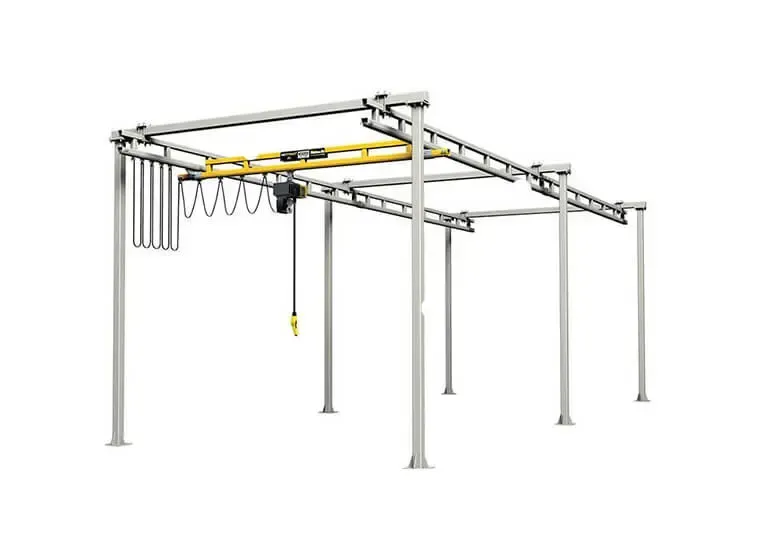

1. Support and installation
A freestanding bridge crane uses its own columns and foundations, so it does not stress your building's roof or beams. Installation usually needs concrete footings and less modification to existing structures. An EOT crane needs properly engineered runway beams fixed to the building. That can mean more upfront building work and structural checks before the crane goes in.
2. Footprint and building work
Freestanding designs let you add overhead lifting without changing the roof or major steelwork. They fit well in leased or expanding shops where you want to avoid permanent building changes. EOT cranes save floor space because the runway sits high, but they require a building that can take the runway loads or an engineered support system.
3. Load capacity and performance
EOT cranes are the go-to choice for heavy, continuous industrial work. They handle higher capacities and long-span coverage. Freestanding bridge cranes often target workstation or cell-level use and are sized for moderate loads with tight positioning needs. Choose based on how heavy your lifts are and how much area you need to cover.
4. Cost and lifecycle considerations
Upfront cost depends on scope: freestanding units can be cheaper if you avoid building reinforcement. EOT systems can cost more up front when runway steel and building strengthening are needed. Over time, electrical control systems and higher complexity on EOT cranes can raise maintenance costs, while simple freestanding systems tend to be less costly to service. Factor both purchase and long-term maintenance when you compare budgets.
5. Flexibility and typical applications
If you need a flexible solution you can move or reconfigure later, freestanding cranes are attractive. They suit assembly cells, light fabrication bays, and shops that change layout. EOT cranes suit high-throughput plants, heavy fabrication, and continuous production lines where the crane must span long distances and handle big loads. Match the crane to your workflow, not just to price.
Free-Standing vs. Jib Cranes
Before choosing between these two crane types, it helps to understand how they affect your daily work. The right choice can improve safety, speed up handling, and reduce worker fatigue. Your layout, load weight, and workflow all play a role.

1. Coverage Area
A jib crane works from a single pivot point. It may be pillar-mounted or wall-mounted. It lifts and moves loads in a circular area, usually between 180° and 360°. This limits how far you can move a load. A free-standing bridge crane covers a full rectangular area. It moves along the runway and also travels across the bay. This creates a much wider working range. You can serve multiple machines, workstations, or assembly points in one line. If your work requires frequent movement across a long or wide area, a free-standing bridge crane gives you better reach and smoother workflow.
2. Floor Space
A free-standing bridge crane requires columns and runway beams. This takes more floor space than a pillar-mounted jib. You need enough room to install uprights and allow safe travel paths. A jib crane fits well in tight corners or narrow work cells. It works when your layout cannot support larger steel structures. However, when you need to cover a full aisle or production line, the extra space used by bridge crane columns becomes worthwhile. You gain coverage across the whole workspace, not just one spot.
3. When to Use Each
Use a free-standing bridge crane when you need full bay coverage and higher lifting power. It works best when you want to move loads along a long line of machines or across multiple stations. For example, if you need to lift up to 10 tons and move parts across a 20-meter machining line, this type fits your needs. Choose a jib crane when you only need to lift and position loads at one location. If you handle 1–2 ton parts at a single machine, a jib crane gives you a simple and budget-friendly solution. Your choice should match how often you move loads, how far they travel, and how much weight you handle.
Pros and Cons of Free-Standing Crane Systems
Free-standing crane systems are self-supported overhead cranes that do not rely on your building's columns or roof. They stand on their own columns and runways. They are a good choice when you need overhead lifting but cannot—or prefer not to—modify the building.
1. Pros
- Independent support – You don't need to reinforce the roof or attach the crane to existing structure. That saves time and avoids costly structural work. It also reduces downtime in occupied buildings.
- Modular and relocatable – you can add, remove or move cells easily.
- Quick deployment – Because they don't need building upgrades, installation is simpler. Lead times and onsite work are usually shorter. That gets you lifting faster and reduces project coordination headaches.
- Wide coverage – Free-standing cranes provide full two-axis coverage across a bay. You can cover multiple workstations with one system. This reduces the need to reposition loads by hand or with secondary equipment.
- Safety and ergonomics – Moving loads overhead cuts down on heavy manual lifts. That lowers worker strain and reduces injury risk. It also improves process consistency and load control.
2. Cons
- Floor space used by columns – The columns occupy some square footage and may slightly obstruct floor layout. They can block aisles or reduce usable floor space. Plan walkways and equipment positions around them.
- Column strength required – The columns and foundations carry the full crane reaction. You must design footings and columns to local codes and soil conditions. That can add design and civil work complexity.
- Initial cost – Compared with a simple jib, a free-standing system costs more up front. But when you factor in building reinforcement or custom roof work, it can still be the economical choice.
- Limited lift height – If you need maximum hook height and heavy capacity, you may require a double-girder layout. That raises the system's weight and installation complexity.
- May not suit extremely wide spans – For very long single-span runs, traditional building-supported cranes or specialized runway solutions can be more efficient. Free-standing cells work well for medium to large spans but have practical limits.
When to Choose a Free-Standing Crane
Free-standing bridge cranes ride on their own columns and rails. They do not rely on your building's roof or runway beams. Choose them when you need flexibility, lower building work, or a relocatable lift solution.
1. No Existing Runway Support
If your building lacks overhead runway beams or corbels, a freestanding crane avoids costly structural upgrades. First, confirm that your floor or foundations can take the loads. Columns transfer crane reactions into the ground. That means you may need new footings or slab reinforcement. Hire a structural engineer to calculate reactions and design anchors. Also check roof and side clearances so the crane fits without unwanted interference. A freestanding crane usually reduces the time and expense compared with adding heavy runway steel to the building.
2. Modular Production Layout
Freestanding cranes work well when you split a shop into separate cells (for example machining, finishing, or assembly). You can give each cell its own crane sized to the task. That reduces traffic and load interruptions between cells. It also makes future layout changes easier. You can install, move, or add columns and spans as the process evolves. When planning, think about aisle widths, transfer points, and how the crane will interact with forklifts and conveyors. Design each crane to the cell's specific span and capacity to avoid overspending for unused capability.
3. Short-Term or Relocatable Need
If the crane is needed for a project, expansion phase, or a temporary operation, freestanding cranes offer clear advantages. They can be disassembled, transported, and reinstalled with less building work than fixed overhead systems. Account for the time and cost of disassembly, transport, and re-certification after reinstallation. Every move usually requires inspection and load testing before the crane can be returned to service.
4. Low-Headroom Situations
When your facility has limited height, a freestanding design can be tailored to maximize usable lift. Options include low-profile trolleys, underslung configurations, or single-girder systems with compact end trucks. These choices reduce the hook-to-ceiling distance and increase effective lift height. Measure clearances carefully. Retrofitting a building to gain height is usually far more costly than customizing a freestanding solution.
5. Cost Considerations
Freestanding cranes can cut costs by avoiding major building work. But cost drivers still exist: crane girder(s), columns and footings, installation labor, permits, and testing. Compare the total installed cost of a freestanding system to the combined cost of runway steel plus building reinforcement. Don't forget lifecycle costs like maintenance, spare parts, and energy for hoists. Also consider downtime during installation.
FAQs
Q: What exactly is a free-standing overhead bridge crane?
A: It's an overhead bridge crane that stands on its own support columns anchored to the floor, rather than attaching to the building structure. In other words, the crane (bridge beam, trolley and hoist) is carried entirely by its own legs, so you don't need roof beams or structural changes in the facility.
Q: How do free-standing cranes differ from normal overhead cranes?
A: The main difference is support. A normal overhead crane needs fixed rails built into the building. A free-standing crane carries itself on floor-mounted columns. This means no building modifications are needed. Other than that, the components (bridge, trolley, hoist, controls) are essentially the same.
Q: What industries commonly use these cranes?
A: Many industries. Common examples are automotive and machinery assembly (overhead cranes for production lines), metal fabrication and steel mills (handling coils, ingots), machine shops and maintenance bays (lifting parts and tools), and warehouses (moving heavy inventory). They're especially valuable in plants that lack crane support beams, like certain warehouses, precast concrete yards, or any retrofitted facility.
Q: Why choose a free-standing crane over a jib crane?
A: A bridge crane (free-standing) moves in two directions and covers a rectangular area, whereas a jib crane only pivots around one pillar (covering a 180°–360° arc). Bridge cranes have a "wider range of motion" and can span whole work areas. Use a jib only if you need to lift in a small area; use a bridge if you need to move loads anywhere in a bay.
Q: What installation is required?
A: You need a solid concrete floor (typically ~6 inches thick) to anchor the crane's columns. The freestanding crane is then assembled on-site (columns bolted down, beams and trolley put together). No overhead cranes or support beams are needed. Because they come as modular kits, they install relatively quickly compared to building new structure.
Q: Can these cranes be moved later?
A: Yes. One of their strengths is modularity and portability. Many designs allow the columns to be unbolted so the crane cell can be disassembled and reassembled in another location. Yuantai's freestanding designs are easy to remove and move quickly if your production layout changes.