- Nov 13, 2024
- News
Overhead Crane for Sale: Yuantai Overhead Crane Lists
Yuantai offers a series of overhead cranes for sale, such as single and double girder types, explosion-proof overhead cranes, and many other types.
Overhead cranes are widely used in many industries as they can be used to lift materials across workshops, warehouses and yards. There are many types of overhead cranes to suit different working conditions, so there are many factors to consider when selecting one. This guide will cover the different types of overhead cranes available, their applications, key factors to consider when purchasing, and how Yuantai Crane can meet your business's specific needs.

What is an Overhead Crane?
An overhead crane is a lifting device that moves heavy or bulky materials across a workspace using a bridge that runs along two parallel runways. This setup allows for precise lifting, lowering, and horizontal movement of loads in controlled pathways. Overhead cranes are often found in warehouses, assembly lines, metal manufacturing, and shipyards, providing solutions for lifting that a traditional hoist or forklift cannot match.
Types of Overhead Cranes Available for Sale
When searching for an overhead crane for sale, it's essential to understand the different types available and their specific uses. Below is an overview of the main types offered by Yuantai Crane, each designed for distinct applications and lifting capacities.
1. Single Girder Overhead Cranes

A single girder overhead crane consists of one main beam that supports the hoist trolley beneath it. It runs on end carriages that travel along runway rails mounted to the building structure. These cranes handle light to medium loads—typically up to 10t—and require less headroom and lower construction cost than double‑girder models. Their simpler design makes them easier to install and maintain.
2. Suspension Overhead Crane
Suspension cranes mount directly to ceiling or roof beams without floor‑level support columns. They free up workspace below by eliminating runway columns. Capacities range from 1 to 10t with spans of 3 to 15m and trolley speeds around 20–30m/min. These cranes suit light‑duty material handling in garages, maintenance bays, and assembly lines where floor space is at a premium.

3. Workstation Overhead Cranes
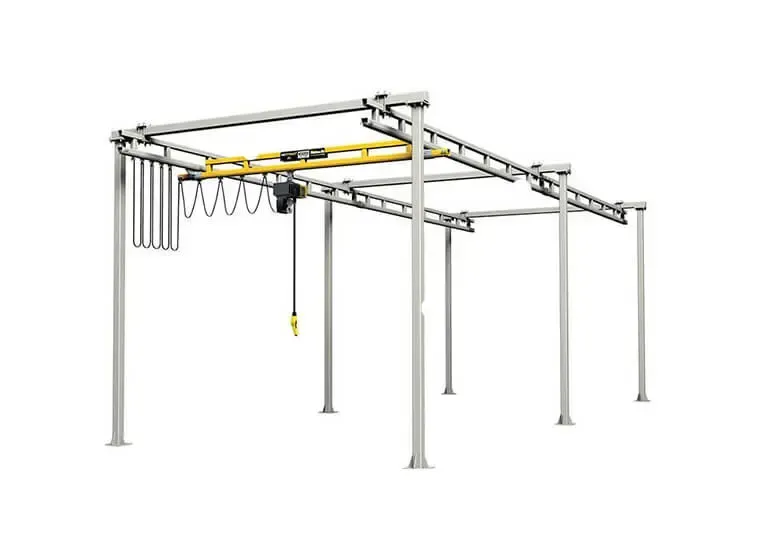
Workstation cranes feature their own support structure of floor‑mounted pillars and beams. They remove the need for building‑mounted runways. Adjustable spans and heights allow precise coverage of individual work cells. Capacities typically run from 0.5 to 3t. Modular bolted sections simplify assembly, relocation, and integration into production lines without altering the building frame.
4. Grab Overhead Crane
Grab cranes replace the hook with a powered multi‑rope grab or clamshell bucket. The grab mechanism securely grips bulk materials—coal, scrap, or grains—then releases them once positioned. These double‑girder cranes incorporate extra cables and pulleys for grab operation. They deliver efficient cycle times in recycling yards, ports, and material‑handling plants by eliminating manual attachment of slings.

5. Explosion-proof Overhead Crane

Explosion‑proof cranes use spark‑resistant materials, sealed motors, and special wiring enclosures to meet ATEX and IECEx standards for gas or dust atmospheres. They feature non‑sparking hooks, conductive paint, and grounding to prevent static buildup. Variable‑frequency drives ensure smooth acceleration without arc generation. These cranes operate safely in petrochemical plants, grain handling, and other hazardous environments.
6. Electromagnetic Overhead Crane
Electromagnetic cranes swap the conventional hook for a lifting magnet. They excel at handling steel plates, bars, and scrap. The magnet's field strength is controlled electrically, allowing rapid pick‑and‑place of ferrous loads. Double‑girder layouts carry larger magnets and heavier loads, while maintaining stable lifting and precise release for plate yards and press shops.

7. Low Headroom Bridge Crane

Low‑headroom cranes mount the hoist to the side of the girder, reducing the hook‑to‑runway dimension. The single‑girder box beam and compact trolley allow hook approaches just a few centimeters below the runway. This design is ideal for facilities with limited clearance or low roof trusses. Despite the smaller profile, these cranes support loads up to 20t and offer full bridge and trolley travel.
8. C Hook Bridge Crane Bridge Crane
C-hook cranes are designed specifically for coil handling. The "C"-shaped hook lifts coils by slipping under their inner diameters. They eliminate the need for slings and the reliability difficulties associated with them. The double-girder design ensures stiffness, and the C-hook attachment rotates the coil for alignment. These cranes are commonly found in steel mills, coil warehouses, and plate processing facilities.

Key Factors to Consider When Buying an Overhead Crane
An overhead crane affects your daily production, your team’s safety, and your overall operating cost. Before you make a decision, take time to understand how the crane will work in your facility. Think about what you lift, how often you lift it, and the environment where the crane will operate. When you match the crane to your real working conditions, you reduce downtime, avoid unnecessary repairs, and get better value from your budget.
1. Load Capacity
Load capacity is the first thing you should confirm. You need a crane that can safely handle your heaviest loads, not just your average ones. Always choose a rated capacity that meets or slightly exceeds your maximum lifting requirement. If you underestimate this, you risk overloading the crane. Overloading can cause serious safety problems. It can also shorten the service life of the hoist, motor, and structure. On the other hand, selecting a crane that is far too large may increase your initial cost without real benefit.
2. Span and Height
The crane’s span and lifting height must match your building layout. The span refers to the distance between the runway beams, and the lifting height determines how high you can raise your load. You should measure your workshop carefully. Check the building width, roof height, column spacing, and any obstacles such as pipes or ventilation systems. If the crane does not fit your structure, installation becomes complicated and expensive. A well-matched crane makes full use of your available space and improves workflow efficiency. Proper planning at this stage can save you from costly modifications later.
3. Frequency of Use
How often will you use the crane each day? This question directly affects the type of crane you should choose. If your operation runs continuously or handles heavy loads every day, you need a more robust solution, such as a double girder overhead crane. It offers higher stability and durability under demanding conditions. For lighter tasks or occasional lifting, a single girder or workstation crane may be enough. Choosing the right duty classification ensures the crane performs reliably without unnecessary wear.
4. Environmental Considerations
The working environment plays a major role in crane performance. If your facility operates in high temperatures, dusty conditions, coastal areas, or chemical plants, standard configurations may not be enough. In corrosive environments, you should consider corrosion-resistant materials and protective coatings. In cold regions, special components may be needed to ensure stable operation. Ignoring environmental factors can lead to rust, electrical issues, or early equipment failure. When you clearly define your working conditions, you can select the right configuration and extend the crane’s service life.
5. Safety Features
A reliable overhead crane must include essential safety features such as limit switches, emergency stop buttons, and overload protection devices. These systems help prevent accidents and equipment damage. For example, limit switches stop the hook from traveling beyond safe positions, while overload protection prevents lifting beyond rated capacity. When you choose a crane with complete safety functions, you protect your operators and your assets. It also helps build a safer workplace culture and reduces the risk of downtime caused by incidents.
6. Compliance with Industry Standards
Compliance with standards such as OSHA and ASME ensures the crane follows strict safety and design requirements. This is especially important if your facility is subject to inspections or certification processes. A compliant crane gives you peace of mind and reduces legal risk. Yuantai overhead cranes are designed to meet international safety standards, providing you with a reliable and compliant solution for a wide range of industrial applications. When you choose equipment built to recognized standards, you invest in long-term safety, stability, and performance.
Comparing Overhead Cranes: A Quick Reference Table
To help you understand the distinctions between various types of overhead cranes, here is a comparison of key features:
| Crane Type | Load Capacity | Best For | Key Advantages |
|---|---|---|---|
| Single Girder Overhead Crane | Light to moderate | Small warehouses, assembly lines | Cost-effective, low headroom requirement |
| Double Girder Overhead Crane | Moderate to heavy | Heavy industry, large spans | High load capacity, robust structure |
| Ceiling-Mounted Suspension Crane | Light to moderate | Space-constrained areas | Saves floor space, flexible configuration |
| Explosion-Proof Overhead Crane | Moderate to heavy | Hazardous environments | Enhanced safety in explosive areas |
| Grab Overhead Crane | Moderate to heavy | Bulk material handling | Efficient for loose materials |
| Ladle Overhead Crane | Heavy | Steel mills, foundries | High heat tolerance, safe for molten metal |
| Workstation Overhead Crane | Light | Production, repetitive tasks | Modular, easy to install |
Why Choose Yuantai Crane?
Yuantai Crane is a leading provider of overhead cranes tailored to meet the diverse needs of industries worldwide. With a strong commitment to quality, compliance, and safety, Yuantai offers reliable and durable crane solutions. Yuantai's cranes are built to meet international standards, providing robust performance, precision engineering, and various customization options. Each crane model undergoes rigorous testing to ensure durability and performance in demanding industrial environments.
- Customization Options: Yuantai offers customization to meet unique project needs, including tailored load capacities, spans, and safety features.
- Support and Maintenance: Yuantai provides full support, including installation, training, and maintenance, ensuring that your crane remains in optimal condition throughout its lifespan.
- Competitive Pricing: With a variety of models to suit different budgets, Yuantai offers competitive pricing without compromising on quality.
Conclusion
Whether you need a crane for light, repetitive tasks or for heavy, demanding applications, Yuantai has a solution that meets the highest standards of quality and reliability. To find the perfect overhead crane for sale for your facility, explore Yuantai's offerings and consult us for tailored guidance on your investment. For more information on Yuantai's overhead cranes, click about us.