- Aug 21, 2025
- News
Workstation Crane: Boosting Efficiency, Safety, Ergonomics
Discover how a workstation bridge crane enhances efficiency, safety, and ergonomics in your workspace. Elevate your operations today for smoother workflows!
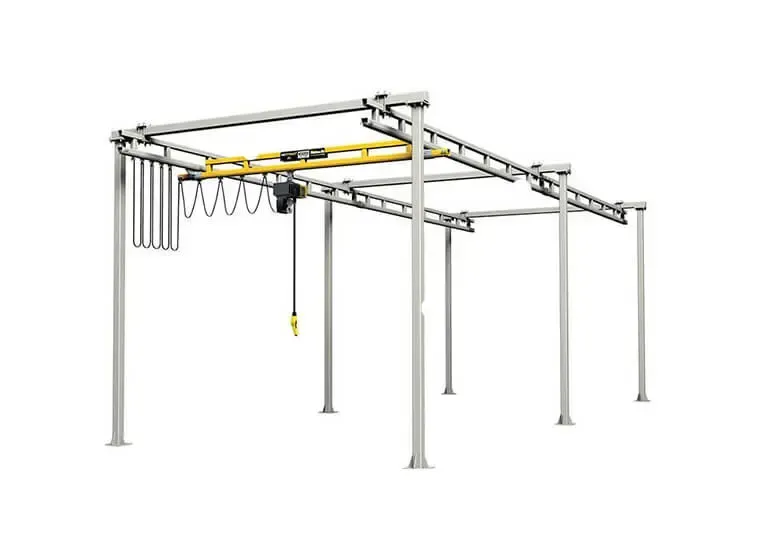
An overhead lifting system devoted to a particular area or work cell is known as a workstation bridge crane, or overhead workstation crane. It moves large loads precisely and safely by spanning a workspace on enclosed trains or runways with a bridge beam. Workstation bridge cranes are frequently constructed from steel or aluminum enclosed track systems and are available in a variety of layouts. They may be customized to fit certain loads and layouts thanks to their modular, kit-style designs. We go over their design and setup, important safety and ergonomic advantages, and how they may be tailored for various settings and industries in the following sections.
Design and Configuration of Workstation Bridge Cranes
Workstation bridge cranes are designed to span rectangular areas over work cells or assembly lines and to fit into tight spaces. Two runway beams (or rails) run parallel to one another in a conventional setup, with a bridge beam in between. The bridge moves along the runways for front-back motion, while a hoist or lifting device is carried on a trolley that moves side-to-side. Important design changes include of:


1. Free-Standing Workstation Bridge Cranes
These cranes are not supported by the building's framework, but rather by columns on the factory floor. They can be put on any concrete floor because they don't require any overhead support. Free-standing cranes are incredibly adaptable; they may be positioned practically anywhere and moved if necessary. This design is perfect for facilities that need to add ergonomic lift assistance without undergoing significant construction because it does not require high ceilings or poured foundations. As with any column, free-standing cranes still need floor anchors and bracing, but because they are so simple to install, there is no downtime when they are moved or expanded.
2. Ceiling-Mounted Workstation Bridge Cranes
These cranes attach directly to the building's steel or concrete roof structure, saving floor space. These systems can span long runways and multiple bridges. When ceilings are tall and unobstructed, ceiling systems are often the lightest and least obtrusive solution. However, if the ceiling can't support it or has obstructions (ductwork, skylights, etc.), free-standing or custom supports are preferable.
3. Enclosed-Track Bridge Cranes
The wheels of the majority of workstation cranes operate inside a U-shaped rail because they are equipped with an enclosed track, which is often made of extruded steel or aluminum. This design offers incredibly smooth and dependable mobility while keeping debris out of the wheels. The "swaying, shimmying, or crabwalking" that open-girder bridges exhibit is eliminated by enclosed-track bridges. This results in minimum maintenance and accurate load positioning. Open I-beam cranes, on the other hand, cause jerky travel because they gather dirt on the bottom flange. Multiple curve profiles for flexibility and optional drop-out portions (for the insertion and removal of trolleys) are made possible by the enclosed track profile.
4. Steel, Aluminum, and Hybrid Systems
Workstation cranes are built from high-grade materials. Steel bridges and runways are common for heavy loads, but aluminum and stainless steel options are available for lighter or corrosive environments. For example, Gorbel's Hybrid Workstation Crane combines the strength of a steel patented track with the light weight of aluminum bridges, giving "the strength and longevity of patented track with the light weight advantages of our aluminum enclosed track bridges". In practice, you might see a steel column and rail with an aluminum bridge beam, or vice versa, based on the application. Aluminum components reduce weight and wear on the hoist, while steel provides rigidity for larger spans. Stainless steel is used for wash-down or chemical facilities. By mixing and matching materials, crane designers can optimize weight, cost, and corrosion resistance for each project.
5. Modular, Kit-Style Workstation Crane Systems
A modular kit design is used by many workstation cranes. On-site, standardized parts such as girders, end trucks, columns, and track sections are bolted together. With this kit-style approach, a modest system may be swiftly delivered, set up, and then enlarged. Modular systems frequently have replaceable end trucks and trolleys, pinned splices between runway segments (which allow for nearly infinite runway length), and optional accessories (such as end stops or interlocks).
6. Customizable Runway and Bridge Lengths
A single cell or an entire line can be covered by a workstation crane. Bridge spans and runway lengths are completely adjustable. Runways can be almost any length because to the bespoke manufacturing and on-site splicing that several manufacturers provide. Odd layouts can be handled using custom support columns, such as those with inverted L forms or uneven heights. In actual use, a workstation crane can be made to fit beneath obstacles, maneuver around bays, or even traverse aisles that connect. In the end, the runway and bridge layout are completely designed to accommodate your floor plan and lifting requirements.
Safety, Productivity, and Ergonomics


Workstation bridge cranes significantly increase workplace ergonomics and safety. They do away with the majority of manual lifting and pushing chores by suspending the load. Rather, a hoist supports the load, and the operator only directs it. This turns a lift that could be dangerous into a controlled overhead maneuver.
1. Ergonomic Lifting
Workers don't need to use their muscles to lift or carry the cargo because the crane's hoist supports it. The force needed to push the cargo along the crane is minuscule—less than one hundredth of the weight. Enclosed-track cranes' smooth wheels and bearings allow for extremely regulated movement, which increases both speed and accuracy. Overall, weariness and the chance of repetitive-strain injuries are decreased by the decreased physical exertion.
2. Improved Productivity
Cycle times are accelerated by lighter, faster movement. This speed increase allows more work to be done in less time in high-cycle applications. Additionally, gentler handling results in fewer rejects because fewer parts are damaged during handling. When a workstation crane is used in place of a forklift or trolley, one employee can manage loads by themselves instead of requiring two persons to move or lift large objects. Workflow is streamlined and floor traffic is decreased with this consolidated approach.
3. Clean, Debris-Free Operation
The design of enclosed tracks directly improves uptime and safety. Chips and dirt don't build up on the rolling surface since the track protects the wheels. This indicates that there is never any jerking and that the wheels always run smoothly with constant friction. In actuality, the crane travels reliably at all times, making load location safer. Less pollution also results in less gear and wheel wear, which reduces maintenance requirements and downtime.
4. Impact-Rated Design
Cranes for workstations are designed to be used frequently. Manufacturers usually incorporate additional capacity into crane designs for safety. This indicates that the crane structure is rated to safely manage a load that the hoist unexpectedly picks up or experiences a shock. These design considerations, which frequently adhere to ANSI/MMA requirements, guarantee that the crane won't break or distort under normal heavy-cycle circumstances.
5. Enhanced Safety Features
Accessories like drop stops (to capture a trolley that has escaped), end-of-runway electronic brakes, or interlocks to avoid collisions in multi-bridge systems are available for many workstation cranes. Crucially, workstation cranes indirectly increase safety by significantly lowering the amount of manual and forklift handling in a work unit. Pallets freeing up floor space also lessens trip dangers. In summary, there is a significant safety benefit to moving material handling to the overhead plane.
6. Easy Installation and Mobility
Without the requirement for foundations or trenching, free-standing workstation cranes can be positioned on an exposed concrete slab. This saves money and time, and if the workflow changes later, the equipment may be moved. Cranes that are fixed on the ceiling simply need to be secured to the roof. Either way, enlargement or relocation is simple because to the modular, bolt-together design.
Workstation bridge cranes, in conclusion, encourage ergonomic lifting, rapid, accurate material transportation, and inherent safety. Workers avoid manual strain, operators can put loads more easily and with less effort, and parts arrive to the workstation more quickly and with less damage. This combination of productivity and safety is frequently unmatched in precision or high-cycle work.
Yuantai Workstation Cranes

Customization and Industry Applications
Workstation crane systems are designed to be flexible so they can adapt to many types of workplaces. Every facility has different lifting needs, available space, and workflow requirements. Because of this, many crane manufacturers offer custom engineering and modular solutions to ensure the system fits the job perfectly. A well-designed workstation crane should match your load capacity, span, lifting height, and building structure. It should also support safe and efficient daily operations. By choosing the right configuration, you can improve material handling, reduce manual labor, and create a smoother production process.
1. Custom-Engineered Solutions
For projects with special requirements, Yuantai can design a workstation crane specifically for your operation. Engineers adjust the crane’s lifting capacity, runway length, support structure, and mounting style to match your facility. Custom solutions are especially helpful when you need to handle unusual loads or work in a challenging environment. For example, some systems are designed to lift materials using vacuum lifters, magnets, or specialized hooks. In other cases, the runway structure may need to follow the shape of an existing building or avoid obstacles such as columns, machines, or ventilation systems.
2. Modular Kit-Style Setups
Many workstation cranes are available as modular kit systems. These systems use pre-engineered track sections, supports, and trolleys that connect together during installation. This design makes the setup process faster and more flexible. Installers can assemble the system on site without complex welding or heavy structural changes. In facilities with complicated layouts, you can combine ceiling-mounted and floor-supported components to create the best arrangement. The modular design also allows future adjustments. If your production line expands or moves, the crane system can often be extended, relocated, or reconfigured with minimal effort. In many cases, installers simply slide the trolley onto the track and connect the rail sections, which speeds up installation and reduces downtime.
3. Typical Applications
Workstation bridge cranes are commonly used in assembly and manufacturing environments where materials must be lifted and moved frequently. These cranes work especially well in production lines, machine shops, maintenance areas, injection molding facilities, pump stations, and core handling operations. In assembly lines, the crane can bring parts directly to the operator from above, which improves efficiency and reduces unnecessary movement. A single runway system can also serve multiple workstations along the same production line. In manufacturing cells such as automotive production, foundries, and fabrication shops, workstation cranes help move heavy components like molds, dies, frames, and large subassemblies. This improves workflow and shortens production cycles. Compact versions are also ideal for confined spaces where floor space is limited. Because the system operates overhead, valuable ground space remains open for equipment and workers. For lighter industrial applications such as electronic assembly or small parts handling, these cranes provide precise and ergonomic lifting that reduces physical strain on workers.
Installation, Productivity and Maintenance Benefits
Beyond the core benefits, workstation bridge cranes offer practical advantages that help buyers make a purchase decision:
1. Ease of Installation
Modular workstation cranes go up fast. Freestanding systems need only floor anchors (no pits or footers), and ceiling systems bolt to existing steel. They can often be installed without shutting down operations for long – especially important in manufacturing. Once anchored, the bolt-together frames and spliced rails are set in a day or two. This means companies can quickly start lifting tasks overhead instead of waiting weeks for construction.
2. Relocation and Scalability
Because of their modular nature, many cranes can be disassembled and moved. If a plant layout changes, a workstation crane can often be lifted onto a pallet jacks or moved by forklift (if designed with removable beams), then re-anchored elsewhere. This flexibility is why manufacturers emphasize "modular design" in their marketing. Expanding capacity is just a matter of adding more track sections or even motorizing travel later.
3. Maintenance and Durability
Workstation cranes are built for high cycles and minimal maintenance. The enclosed-track wheels run in oil-free bearings, so they rarely need lubrication. As noted, debris is kept away from contact surfaces. Motorized options (like travel drives on the bridge or trolley) can improve throughput, but even manual (pushed) systems remain remarkably smooth. With proper maintenance, these cranes last for decades.
4. Compliance and Training
Modern workstation crane systems can include force limited or intelligent controls to meet updated OSHA/ANSI regulations. For example, many use electric or air balancers with drop stops to prevent free-fall if the operator lets go. Also, because these cranes essentially enforce good lifting posture (operators stand upright and steer the load), some companies find they comply with workplace ergonomic standards more easily. Vendors often provide training for safe use as part of the package.
Conclusion
Workstation bridge cranes provide an efficient and adaptable lifting solution for modern manufacturing and assembly environments. Their modular design, available in free-standing or ceiling-mounted configurations, allows customization of span, capacity, and runway length to suit specific work areas. With enclosed steel or aluminum tracks, they offer smooth and safe load movement while reducing the physical strain on workers. By minimizing manual lifting and reliance on forklifts, these cranes improve ergonomics, enhance productivity, and lower the risk of injuries, making them well suited for applications ranging from automotive plants to small workshops.