- Sep 16, 2025
- News
Industrial Warehouse Crane for Sale
Cranes commonly used in industrial warehouses are overhead cranes, portable gantry cranes, jib cranes, and ceiling cranes.
Warehouses are important facilities for industrial production, storage and transportation industries. Whether you need an indoor warehouse crane for light lifting tasks or a warehouse ceiling crane for heavy-duty operations, selecting the right equipment is critical for seamless workflow management.

Warehouse Overhead Cranes
Warehouse bridge cranes provide overhead lifting and horizontal transfer across storage bays and production floors. They free the floor from obstructions. They speed pallet handling, machine placement, and pallet-to-dock transfers. Choose the crane that fits your loads, building, and workflow.
1. Single-Girder Overhead Cranes
If you need reliable lifting operations and don't want a complicated design, single girder overhead cranes are a practical alternative. They use a single main beam under which the lifting mechanism operates, thus keeping the system compact and efficient. Designed for light to medium lifting operations, it is less expensive to purchase and install than a double girder overhead crane and places less load on the building structure. Due to the small headroom they require, they are ideally suited for small to medium sized workshops and warehouses. There are three main types of single girder overhead cranes depending on the application.
1.1 Top-Running Single-Girder Overhead Crane
A Top-Running Single-Girder Overhead Crane runs on rails mounted on top of the runway beams. The end trucks sit on the rail flange, which creates a stable travel path for the crane and allows the hoist to move smoothly under the girder. This setup transfers higher wheel loads to the runway, so the building structure must be able to handle those forces. You may prefer this type if you want a straightforward and durable crane layout with good lifting performance. It works well in facilities with strong columns and runways, and it supports steady operation in busy industrial environments.
1.2 Ceiling-Mounted Single-Girder Overhead Crane
A suspension or Ceiling-Mounted Single-Girder Overhead Crane hangs directly from the roof structure instead of running on floor-supported columns. This design keeps the shop floor open and free from obstructions, which helps when space is tight or traffic flow is important. It is best suited for lighter loads and shorter spans, since the roof or purlins must safely support both the crane and the lifted weight. You may choose this option if you want to maximize usable floor space and your building frame is designed to carry suspended loads without extra reinforcement.
1.3 LDP Low-Headroom Single-Girder Overhead Crane
The LDP low-headroom single-girder uses a single beam with a side-mounted hoist so the hook can reach higher without needing more headroom, making it ideal for older plants, low-ceiling workshops, or compact production areas. Its compact and rugged construction, utilizing high strength steel and precision engineering, provides users with reliable, smooth lifting and operating performance. It is a cost-effective option for locations that require aerial lift operations in confined vertical spaces.


1.2 Double-Girder Overhead Cranes
Double-girder cranes use two parallel main beams and a trolley that runs between or on top of them. They support higher capacities and longer spans. They give extra hook height because the hook hangs between girders. Use double-girder cranes for heavy manufacturing, large warehouses, and lifting tasks that demand higher duty cycles. These cranes are stiffer, so they reduce bridge deflection and improve positioning when moving big loads.
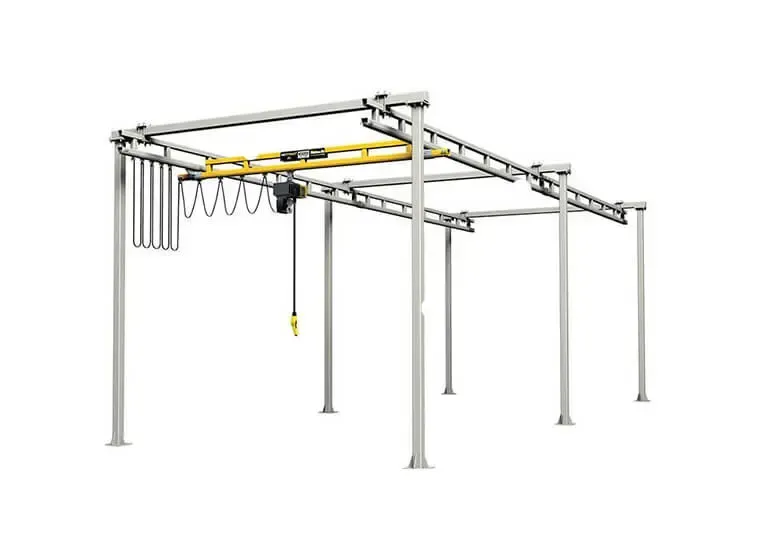
1.3 KBK Freestanding Crane Systems
KBK is a modular light-crane system built from standard rails, trolleys, and hoists. It suits low-capacity lifting at many workstations. You can mount KBK as ceiling-hung or as a freestanding workstation bridge. It assembles with bolts and brackets. The system installs fast and adapts when layouts change. Use KBK in assembly lines, clean rooms, and ergonomic lifting stations where loads are light and repeated.

2. Jib Cranes
Warehouse jib cranes provide fast, local lifting at a single station or along a short run. They free forklifts from repetitive short moves. They speed order picking, machine loading, and light assembly. Jibs fit where a full bridge crane is unnecessary or impractical.
Wall Travelling Jib Crane
A wall travelling jib runs on a horizontal rail fixed to a building column or beam. The boom travels along the rail and still swings at the head. This gives linear coverage plus radial reach. Fit it along long racking runs or assembly lines. It reduces aisle congestion. Installation needs a strong wall or beam and regular rail inspection. Controls are usually pendant or radio remote. Add limit switches, slew stops, and overload protection for safe operation.
Wall Mounted Jib Crane
A wall mounted jib bolts to a sturdy column or wall. The boom swings through a fixed arc. It occupies no floor space and keeps the work area clear. Use it at single loading doors, packing stations, or machine benches. Verify the building structure can take the load before specifying this type. Standard options include fixed or swivel mounts, top- or base-mounted bearings, and optional trolley travel for inboard/outboard reach.
Mobile Jib Crane
A mobile jib sits on a wheeled base or castor frame. You move it where you need short-term lifting. It works well for seasonal tasks, temporary lines, and field service. Choose models with lockable wheels and rated stabilizers. Battery-powered hoists and powered casters add autonomy on large floors. Inspect footing and wheel condition often to avoid instability during lifts.
Floor Mounted (Pillar) Jib Crane
A floor mounted jib uses a single pillar anchored into a reinforced pad. The boom usually rotates 180°–360°. This type gives a compact, robust lifting point. It suits service pits, presses, and fixed workstations. Foundations and anchor bolts must be sized for overturning and dynamic loads. You can specify slewing drives, slew locks, and integrated fall-protection for maintenance access.


3. Portable Gantry Cranes
Warehouse gantry cranes provide ground-level mobility and flexible coverage. They move heavy loads without building-mounted runways. Choose a gantry when you need span coverage, mobility, or temporary installation. Consider capacity, span, ground conditions, and power before you buy.
3.1 Single-Girder Gantry Crane
A single-girder gantry crane uses one main beam that supports the hoist trolley beneath it. It is lighter and less expensive than double-girder types. Use it for light to medium loads, order picking, and occasional staging tasks. Design points include the girder profile, wheel diameter, and end-carriage drive. Specify wheel material to match floor surface. Check wheel loads against your slab or rail. Single-girder gantries are easy to assemble and move. They work well where headroom and budget are limited.
3.2 Double-Girder Gantry Crane
Double-girder gantries have two parallel main beams and a top-running or between-girder trolley. They carry heavier loads and longer spans than single-girder units. Use them for heavy pallet stacks, large machinery, and continuous yard handling. Structural stiffness reduces deflection and improves positioning. Pay attention to end-truck design, rail alignment, and foundation reactions. These cranes need stronger ground preparation. Choose double-girder when capacity, repeatability, or hook height matters.
3.3 Custom Semi-Gantry Crane
A semi-gantry crane mounts one end on a runway and the other on legs that travel on the floor. This hybrid saves one row of runway supports and reduces building modification. It suits dock edges, machine tool lines, and situations with a clear side. Custom semi-gantries let you tailor leg height, span, and travel length. Specify travel drives, wheel types, and anchors to match site conditions. They are a good compromise when partial building support is available.
3.4 Portable Gantry Crane
Portable gantry cranes are wheel-mounted frames you can move by hand or with powered casters. Aluminum models are lightweight and easy to reposition. They suit cleanrooms, maintenance bays, and mobile service teams. Steel portable gantries are heavier but give higher capacity and greater durability. They work well in fabrication shops and outdoor staging areas. For both types, check caster rating, locking brakes, and beam extension options. Confirm the ease of assembly and the availability of lifting accessories.


Factors to Consider When Choosing a Warehouse Crane
It takes more than just choosing a model that appears sturdy or meets your budget to choose the best warehouse crane. It necessitates examining your facility, operations, and the kinds of loads you deal with on a daily basis. A well-selected crane can decrease the need for physical labor, increase productivity, and lower the chance of mishaps. However, a badly designed crane can shorten the equipment's lifespan, increase maintenance expenses, and cause bottlenecks. The following elements should be carefully considered to ensure that your crane investment yields long-term benefits.
1. Load Requirements
Every warehouse crane must be sized around the heaviest and most common loads it will handle. It is not enough to think about average weights. Instead, you should calculate the maximum load and consider its shape, center of gravity, and how stable it is during lifting. Long or flexible items, such as steel pipes or fabric rolls, require different rigging compared to compact pallets or containers. It is also wise to allow a margin for unexpected lifts, so the crane is not pushed to its limits. Oversizing slightly can protect both the equipment and your operations.
2. Span and coverage area
The physical layout of your warehouse directly shapes the crane you need. Measure the span of the bay, the length of travel, and the height at which loads must be handled. A single long-span crane might seem efficient, but in some cases, using two smaller cranes for different zones provides more flexibility. Keep in mind that longer spans require stronger girders, which add weight and cost. If your warehouse has multiple workstations, think about whether each station needs full coverage or if shared access is enough.
3. Headroom and lifting height
Space above the floor can be just as important as the floor area itself. A warehouse with low ceilings may require compact hoists or special low-headroom designs to maximize the hook path. On the other hand, if tall storage racks or mezzanines are in use, the crane may need a higher lifting height than standard models provide. In such cases, a double-girder crane is often chosen because it allows the hook to rise closer to the ceiling, giving more usable lifting height. Taking precise measurements early prevents surprises during installation.
4. Duty cycle and operating hours
Not all cranes are built to work at the same pace. A crane used occasionally for light handling can be simpler and less costly, while a crane that runs all day across multiple shifts needs heavy-duty components. The duty cycle—how often the crane operates and how demanding each lift is—helps define the right service class. If the crane will be part of a production line or high-throughput warehouse, select industrial-grade gearboxes, motors, and hoists designed for continuous work. Choosing the right class prevents early wear and reduces downtime.
5. Hoist type and speed control
The hoist is the heart of the crane, and its design should match your lifting needs. Wire-rope hoists are best for heavy loads and long lifts because they provide smoother movement and longer service life. Chain hoists, on the other hand, are compact, easy to maintain, and well-suited to lighter, repetitive lifting. Speed control is another key point. A simple single-speed hoist may be enough for general handling, but for precise placement, dual-speed or variable frequency drives (VFD) give operators more control. Smooth starts and stops also reduce load swing, which increases safety.
6. Precision and control requirements
Some warehouse operations require more than just lifting and lowering. If your work involves exact positioning—such as placing molds, stacking fragile goods, or feeding machinery—you may need advanced control features. Options include inching for small movements, encoder feedback for accuracy, and even PLC-controlled automation for synchronized lifts. Enhanced control systems reduce operator strain, speed up tasks, and lower the risk of accidents caused by misaligned loads.
7. Floor, runway, and foundation constraints
Before installation, it is essential to check the building’s structural strength. Cranes put significant forces on floors, columns, and beams. Free-standing systems need properly designed pad foundations to handle wheel loads and prevent tipping. If the crane will run on a building-mounted runway, a structural engineer should confirm that the supports can carry the extra weight. Overlooking this step can lead to costly reinforcement work later.
8. Environment and special conditions
Finally, the working environment plays a major role in crane selection. Temperature extremes, humidity, dust, and chemicals can all affect crane components. Outdoor cranes must be fitted with weatherproof motors, covers, and protective coatings. In industries where flammable materials are handled, explosion-proof hoists and controls are mandatory for safety compliance. Even in a clean warehouse, good ventilation and regular maintenance help extend crane life.


Applications of Industrial Warehouse Cranes
Industrial warehouse cranes are widely used across different industries because of their ability to lift, move, and organize heavy materials with precision. They improve efficiency, reduce manual labor, and enhance workplace safety. By integrating cranes into warehouse operations, companies can streamline material handling, minimize downtime, and maximize the use of available space. These advantages make them essential equipment for both small workshops and large-scale industrial facilities.
1. Chemist Warehouses
In chemical and pharmaceutical storage, cranes are often used to handle sensitive, bulky, or hazardous materials. They allow workers to move large drums, sealed containers, and chemical pallets without direct physical contact, reducing the risk of spills and exposure. Specialized cranes with anti-spark features or explosion-proof designs are sometimes used in these environments to ensure maximum safety. By enabling careful and precise lifting, warehouse cranes help maintain strict compliance with safety and environmental regulations.
2. Manufacturing
In manufacturing plants, cranes play a central role in keeping production lines moving. They are used to transport raw materials like steel plates, coils, and heavy components to the right workstation. After production, the same cranes assist in moving finished products to storage or loading areas for shipment. Overhead and gantry cranes are common in this setting because they provide consistent lifting capacity and can cover large areas of the factory floor. The use of cranes also reduces reliance on forklifts, making material flow more streamlined and less congested.
3. Storage Facilities
Storage and logistics warehouses rely on cranes to efficiently manage inventory that is too heavy or bulky for manual handling. Large crates, machinery, or palletized goods can be lifted and placed in racks or onto trucks with ease. Automated crane systems are sometimes integrated with warehouse management software to improve accuracy in item retrieval and placement. This not only saves time but also ensures optimal use of vertical storage space, allowing facilities to store more goods without expanding floor space.
4. Repair Shops
In automotive, aerospace, and heavy equipment repair shops, portable gantry cranes are especially useful. They provide flexibility for lifting engines, machinery parts, or vehicle components that need inspection or replacement. Because these cranes are mobile and easy to set up, they can be positioned wherever needed, making them ideal for temporary lifting tasks. Their versatility reduces downtime during repairs and ensures that technicians can work more safely and efficiently.
Conclusion
Industrial warehouses tend to be indoor applications where space is limited, so smaller cranes with smaller footprints are often ideal. In some special warehouses, such as chemical warehouses, specialized cranes are required to protect against chemicals. Cranes are a customized product. No matter what your application environment and application needs are, Yuantai can provide you with a customized solution to meet your lifting needs.